Daves Home Page |

When Hobbies Collide: Woodworking Meets Music
Fabricated from hardwoods: Bubinga (African Rosewood), Maple, Purpleheart, and Rosewood, this custom made guitar combined two hobbies into one goal.
I've always been involved in woodworking to some extent and also playing guitar. When a friend of mine who is experienced as a luthier asked if I would like to try my hand at building a guitar, I jumped at the opportunity.
The process started with rough designs on paper and then a full size paper template was made of the body shape and headstock. The stock lumber was planed to a uniform thickness, ripped to approximate size and finally cut to shape with the template on a band saw. The body is composed of three different kinds of wood: Bubinga (African Rosewood), Maple, and Purpleheart. It is fabricated from 7 distinct pieces of stock: Right and left body halves along with the headstock are Bubinga, the through-the-body neck is made of one strip of purpleheart sandwiched between two strips of maple. The last piece is the Rosewood fingerboard on the neck.
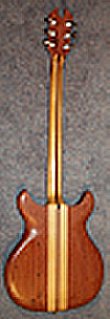
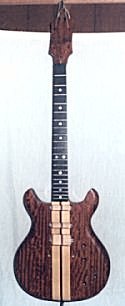
The three main neck pieces were assembled, cut to the proper neck angle and a channel cut to accept the truss rod, under the fretboard. The headstock was cut from its template and attached to the neck assembly. The right and left body sections were then attached to the neck assembly to form the guitar.
The next step was to locate and install the bridge post mounting screws and the "nut" at the head end of the neck. The distance between the two would determine the rough calibration for the guitar. The body cavities were then cut with a router in the front for the pickups and in the back for the control cavity.
When the major cutting was done, the process continued with contouring the body sections. This accomplished whatever esthetic qualities I wanted in the guitar as well as contouring for ease of holding the guitar while playing. This part was the most time consuming as all the wood removed was done with hand tools. I could have taken some wood off with a power tool but as this was my first project I did not want to chance any runaway gouges. When all the contouring was done, the scraping and sanding commenced. Scraping allows the end grains to be as smooth as surface grains but take a lot longer on inside curved surfaces.
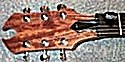
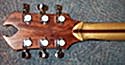
The last woodworking step was applying a finish. I've always been partial to natural wood finishes and I decided to leave as much of the wood showing as possible. I applied 30+ coats of Tung Oil to the guitar, buffing in-between each coat. It ended up with a very smooth but subdued shine.
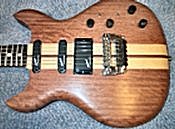
The hardware went on next. I used Gotoh ™ tuning keys, two EMG Select ™ single coil pickups, one EMG Select ™ Humbucker with reverse phase capability for the bridge pickup, and a Schaller Micro-Tune ™ bridge.
But how does it play: very smooth, low action and good sustain. Due to the wood involved, it weighs a quite a bit but I'm comfortable with that from playing my Les Paul.
The whole project was about a 24 month "labor of love". This included the concepts, design, locate and purchase parts, redesign, normal work and overtime, time with the family, until the point where .
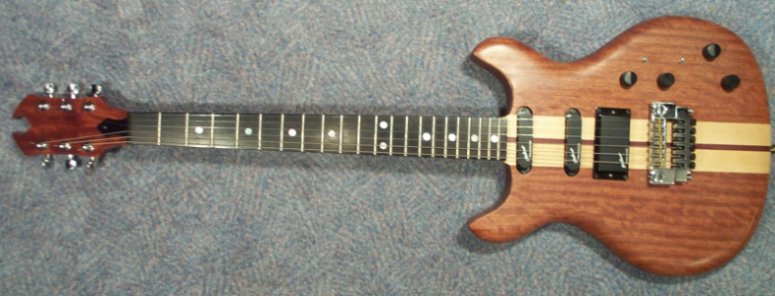 The full image is 672K